
Women's Circle Facilitator Certification Online: How to Choose the Right Training
- Imogen Bailey

- Apr 15
- 6 min read
There's a moment that happens for women who are meant to facilitate Circle. It usually arrives quietly. You're sitting in a Circle yourself, or reading about one, or remembering a conversation that felt different from the others — and something in you says, I could hold this. I want to hold this.
If you've had that moment, what comes next is the question of how. And if you've started looking at online certifications, you've probably noticed something I noticed when I started training other women a decade ago: there are now hundreds of them. They range from $200 weekend workshops to $5,000 multi-month programs. Some teach Circle as a spiritual practice, others as a coaching tool, others as something closer to group therapy. A few are extraordinary. Many are not.
This article isn't going to tell you which one to pick. It's going to give you the five things that actually matter when you're choosing — and a few things that look impressive on a sales page but don't translate into your ability to hold a real Circle when the moment comes.
I've spent the last decade training Facilitators, building one of the few accredited programs in this space, and watching graduates of every type of training walk into rooms full of women. So this is the buyer's guide I wish someone had written for me.
What to look for in a Women's Circle Facilitator Certification
1. Real accreditation, from a recognised body
This is the one most people overlook because it sounds bureaucratic. It's not. Accreditation matters because it tells you the curriculum has been independently assessed against a standard. Without it, you're trusting the marketing copy.
In Australia, look for IICT or IPHM accreditation. In the US and UK, look for IACET or programs aligned with the International Coaching Federation framework where relevant. The body matters less than the existence of one. If a program lists no accreditation at all, ask why — and listen carefully to the answer.
Accreditation also matters if you ever plan to charge for your Circles. Insurance providers, councils, retreat venues and corporate bookers will increasingly ask whether your training is recognised. Without accreditation, you may find doors closed that you didn't know existed.
2. Practical facilitation training — not just theory
Reading about Circle is not the same as facilitating one. The two skills barely overlap.
A good certification spends most of its time on the actual mechanics of facilitation: how to open a Circle, how to hold silence, how to invite a quieter voice without putting a woman on the spot, how to manage the moment when one woman dominates and the room goes flat, what to do when someone cries, what to do when no one wants to speak. These are practical skills. They have to be taught practically.
If a program is mostly recorded videos of someone explaining what Circle is, you will graduate knowing what Circle is. You will not necessarily know how to hold one. Look for programs that teach the moves, not just the meaning.
3. Live practice with supervision
This is where most online programs fall over. Reading and watching are passive. Holding Circle is active. Without practice, the gap between your knowledge and your capacity stays wide.
A strong certification builds in opportunities to practice — ideally facilitating peer Circles with other students, with a trained Facilitator observing and giving feedback. This is also where the deepest learning happens, because feedback from someone who has actually held hundreds of Circles is gold.
If a program offers no live element at all, you can still learn from it — but you will need to do your own practice work afterwards. Plan for that, and be honest with yourself about whether you'll actually do it.
4. Ongoing community after certification
The day you finish a certification is the day the real work begins. The first few Circles you hold will raise questions you didn't know to ask. Some women will surprise you. Some will challenge you. Some will tell you things that are heavy to hold.
A good certification doesn't disappear once your final module is complete. It gives you a community — other Facilitators at every stage of the journey, a place to bring questions, a network of women who are doing this work alongside you. This is what stops new Facilitators from quietly giving up in their first six months.
If a program ends with a certificate and a Facebook group that hasn't been active in a year, take that seriously. The lonely Facilitator burns out. The connected one keeps going.
5. Founder credibility and lineage
Look at the person who built the program. Have they actually facilitated Circles for years, or did they read about it and build a course? Are they still teaching, or have they stepped back from the work itself? What do their graduates say — not in the testimonials curated on the sales page, but in the open conversations on Substack, Reddit, and in Facilitator communities?
Lineage matters too. Circle is not a new practice. It draws from indigenous women's councils, restorative justice circles, Quaker meeting traditions, and contemporary therapeutic work. A Facilitator trained by someone who is honest about where the practice comes from — and respectful of those origins — will pass that integrity on to you.
What good online certification actually looks like
Online doesn't have to mean diluted. The best online programs combine self-paced learning (so you can fit it around your life) with live elements (so you don't lose the heart of the practice). What you're looking for is:
Self-paced video and reading modules for theory, structure, and the building blocks of Circle
Live calls or group sessions with the trainer and other students, scheduled at workable times across timezones
A practice container — a peer Circle, a practicum, or a structured opportunity to facilitate before you graduate
Lifetime or long-term access to the materials, because you will return to them
An active alumni community with a real teaching presence, not just peer discussion
If those five things are in place, an online certification can be every bit as rigorous as an in-person one — and considerably more accessible.
Pricing reality — what to expect
You will see Women's Circle Facilitator certifications priced from around $200 to over $5,000. That range tells you almost nothing on its own. What it tells you when combined with the five criteria above is whether the price makes sense.
A $200 weekend course with no accreditation, no live practice, and no ongoing community is not a bargain. It's a pamphlet you paid for. A $5,000 program with full accreditation, supervised practice, and a thriving alumni community might actually be the cheaper option, calculated per Circle you'll go on to hold.
For most women, a payment plan starting from around $59 a month — with a fully accredited, full-curriculum program in the $500–$2,000 total range — is a sensible benchmark. Below $500, ask hard questions. Above $5,000, ask whether you're paying for the training or for the brand.
Red flags worth slowing down for
Three things I see that should make you pause:
Spiritual gatekeeping. Programs that require you to align with a specific belief system, do specific energy work, or be "activated" by the lead teacher before you can certify. Circle is a practice anyone can hold. You shouldn't need permission from a spiritual authority to do it.
Unverifiable graduate numbers. "Over 10,000 women trained" with no public record of who, when, or what they're doing now. Real numbers tend to come with real Facilitators you can actually find.
No refund window. A program that won't let you exit in the first week is a program that doesn't trust its own offer. Most reputable trainings now offer a 7–14 day window so you can experience the first module before fully committing.
A note on whether you're really ready
The truth is most of the women I've trained were ready before they thought they were. The pull you feel toward facilitation is usually accurate. What stops women is rarely capacity — it's the belief that they need to be more qualified, more healed, more something before they're allowed to step into the role.
You are allowed to start before you feel ready. The training is what bridges the gap.
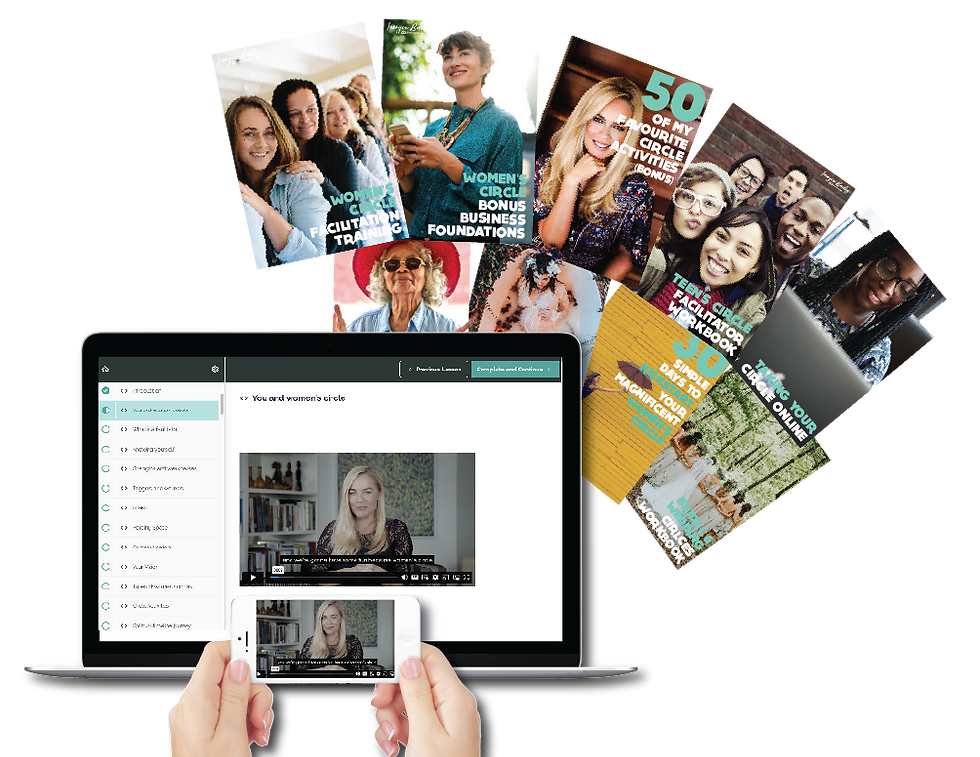
If you'd like to know more about how we approach this at Honouring Heart, our Ultimate Circle Facilitator Bundle is a fully accredited, self-paced certification with live community support, lifetime access, and a payment plan starting at $59 a month. We meet all five criteria above — which is what we built it to do.
If you're earlier in the journey and want to begin with something smaller, the free Connection Blueprint is a practical guide to building deeper connection and hosting your very first Circle. No certification, just the foundations.
And if you're still working out whether facilitation is the right path for you, you might also like our pieces on what a Women's Circle is and how to start a Women's Circle of your own.
Wherever you are, there's a way in.
With love,
Imogen x


Comments